I remember when a tag like this was bolted to the front bumper of many of the local vehicles. This one I came across at a garage sale several years ago. They're a rarity nowadays, so rare that I keep this one in my apartment rather than risk damaging it by placing it on my vehicle. If you are aware of others like this one, let me know - I'd love to buy them.
Sunday, September 29, 2013
OLD VICKSBURG CONFEDERATE CAR TAG
I remember when a tag like this was bolted to the front bumper of many of the local vehicles. This one I came across at a garage sale several years ago. They're a rarity nowadays, so rare that I keep this one in my apartment rather than risk damaging it by placing it on my vehicle. If you are aware of others like this one, let me know - I'd love to buy them.

Friday, September 13, 2013
ANOTHER CS OVAL BUCKLE

 I didn't dig this one - a fellow relic hunter discovered it in a Bovina camp under a tree that had been downed by a storm. He had hunted for hours without digging anything worthwhile when he spied the large excavation created by the uprooted tree. Within a short time he'd located the buckle with his metal detector. One never knows, does one?
The plate is of the thin, stamped brass, rope border, western-style, and, fortunately, has retained all three belt clips. It appears as though the Confederate soldier who discarded the buckle had inserted a bent nail between and under the clips. Perhaps he had a very thin belt that he fitted between the clips and under the nail.
Monday, September 2, 2013
RARE 3" MULLANE/TENNESSEE SABOT CONFEDERATE ARTILLERY SHELL
There's an interesting story behind this shell and its companions. Way back in the early sixties a local Vicksburg relic hunter (a good friend of mine) noticed the tang (if that's the correct word) of what he assumed was an old farm implement projecting from the Big Black River near the site of the old town of Bridgeport, Mississippi. Later, he regretted his error, for the "tang" was a part of an artillery caisson that had fallen from the bridge at that location as Sherman's troops were galloping toward Vicksburg after the Battle of Champion Hill. Another person (I assume a relic-hunter) came along later and pulled the caisson, along with its load of 3" Confederate shells, from the river. If you're wondering why the Union troops were pulling a caisson loaded with Confederate munitions... The caisson had been left behind by the Confederates after the battle; Sherman's men knew they could fire the shells in their own 3" rifles, so they took them along. However, the caisson was lost when it fell from the Bridgeport bridge.
In the ensuing years some of the shells were sold or given to collectors, but at some point most of them were given or sold to the Grand Gulf museum, where they resided for many years - until some unscrupulous scoundrel absconded with all that remained. The shell pictured is a great example of the group. A portion of the wood sabot and the center bolt remain, and the protrusions from the cast iron to the brass portion of the sabot are evident.
Years later, as I was hunting the artillery emplacement of the First Missouri Light Artillery in south Vicksburg I dug one of these shells that had been fired by Confederate troops; Sherman obviously didn't capture them all!


Saturday, August 24, 2013
CIVIL WAR DRUMMER'S INSIGNIA
 I dug this one years ago at a local 1860s camp and at first couldn't figure out what it was. I finally found a similar piece in Harris' civil war relic book (page 209). There are apparently very few of these recovered.
Friday, August 16, 2013
POST-MORTEM PHOTOGRAPH NATCHEZ
 This is a photo of a cased post-mortem daguerreotype that I bought from a gentleman several years ago. According to him, the young girl was the daughter of a family from Natchez who owned one of Natchez' old (antebellum) homes. He said the home was located just outside the Natchez city limits, but he did not know the name or the owner of the house.
Apparently, post-mortem photographs of young loved ones were common and acceptable in the 1850s, which is about the date of this one.
Collecting artifacts from the past is a never-ending source of surprise and gratification; an artifact like this one is a perfect example.
Thursday, August 8, 2013
CANNON BALL DIGGIN' BACK IN THE GOOD OLE DAYS
 These are some photos from years back when the "cannon ball digging" was really hot. Included is a photo of the first artillery shell my son and I ever dug in 1967 or 1968 - a 3.8" James type I. We didn't know what the heck we'd dug until a fellow digger identified it for us.
 This is a photo of one day's dig back in 1979 while I was experimenting with long hair and a beard (ugh!). I remember I had a heck of a time carrying all those shells from the woods. The detector is an old Fisher Research with a 13" head.
I loved the wool jacket I was wearing in the last photo. It was made for me by the mother of one of my girlfriends back when I was single. Unfortunately, it burned during a house fire in 1982.
Wednesday, July 31, 2013
COCA-COLA, BIEDENHARN, AND VICKSBURG
 Joseph Biedenharn of Vicksburg was the first to bottle Coca-Cola. From the Biedenharn Museum website:
"In 1894, Joseph A. Biedenharn, a country businessman in Vicksburg, Mississippi, and owner of the Biedenharn Candy Company, made a world changing decision. In order for his customers outside downtown Vicksburg to have Coca-Cola, he had his brother Herman put Coca-Cola in a bottle, making the Biedenharn Candy Company the first to ever bottle Coca-Cola. Today, Coca-Cola is sold in more than 200 countries."
Under Joe's leadership, his brothers, sons, and grandsons, established plants in Louisiana, Mississippi, Texas, and Arkansas eventually becoming the ninth largest bottling corporation in the United States."
Coca-Cola collectibles range from the 1894 period through present day, including original bottles and the large metal side plate from a Coke cooler pictured above. Local bottle diggers often discover the original Hutchinson style bottles while digging local bottle dumps.
Saturday, July 20, 2013
WWII NAZI CAP
 I can't take credit for finding this one, but it "walked" into my place a while back along with some other assorted Nazi items, including more caps; the same fellow who found these also brought several Nazi caps to me a couple of years ago. Some of the caps are in poor condition, having been found in the attic of an abandoned house. But they are in demand by collectors of WWII relics.
Friday, June 28, 2013
WWI ERA ARTIFACTS FOUND LOCALLY


 This rare cartridge belt, designed as a complement to the "Model 1903 rifle," was found here in Vicksburg. It's prior owner probably participated in WWI, the "Great war."
  A number of unopened boxes of rare rifle cartridges were found along with the belt. The cartridges shown here were made by Winchester for a .41 caliber Swiss rifle and are marked ".41 Swiss Smokeless Rim Fire." Additional cartridges are shown on the Adolph Rose Antiques website.
Thursday, June 20, 2013
GOLD CRUCIFIX… FROM A TRASH BAG
 It's amazing what people will throw out when they're cleaning house. This 2" Crucifix - marked 14K - along with various and sundry other gold and gold-plated jewelry was recovered from a trash bag placed alongside the street for pickup by the Vicksburg city garbage haulers. I can't take credit for finding it, though I'm not above dumpster-diving myself.
Tuesday, June 11, 2013
THE HEART OF LOUISVILLE, KENTUCKY
 This large (5" vertically) brass/lead heart-shaped device came from a trash dump here in Vicksburg. It features in relief the capital building in Louisville, Kentucky. It's intriguing in that it appears to be a very thin brass stamping with a very thin lead backing. If that's the case, it is quite old - possibly War Between the States old. It's use is not known. One never knows what he might find in the trash dumps of this old town.
Wednesday, June 5, 2013
COMPOSITION BLACK BABY DOLL
 From a local estate sale, this little composition doll is in amazingly good condition, having apparently been in the same family for quite a while.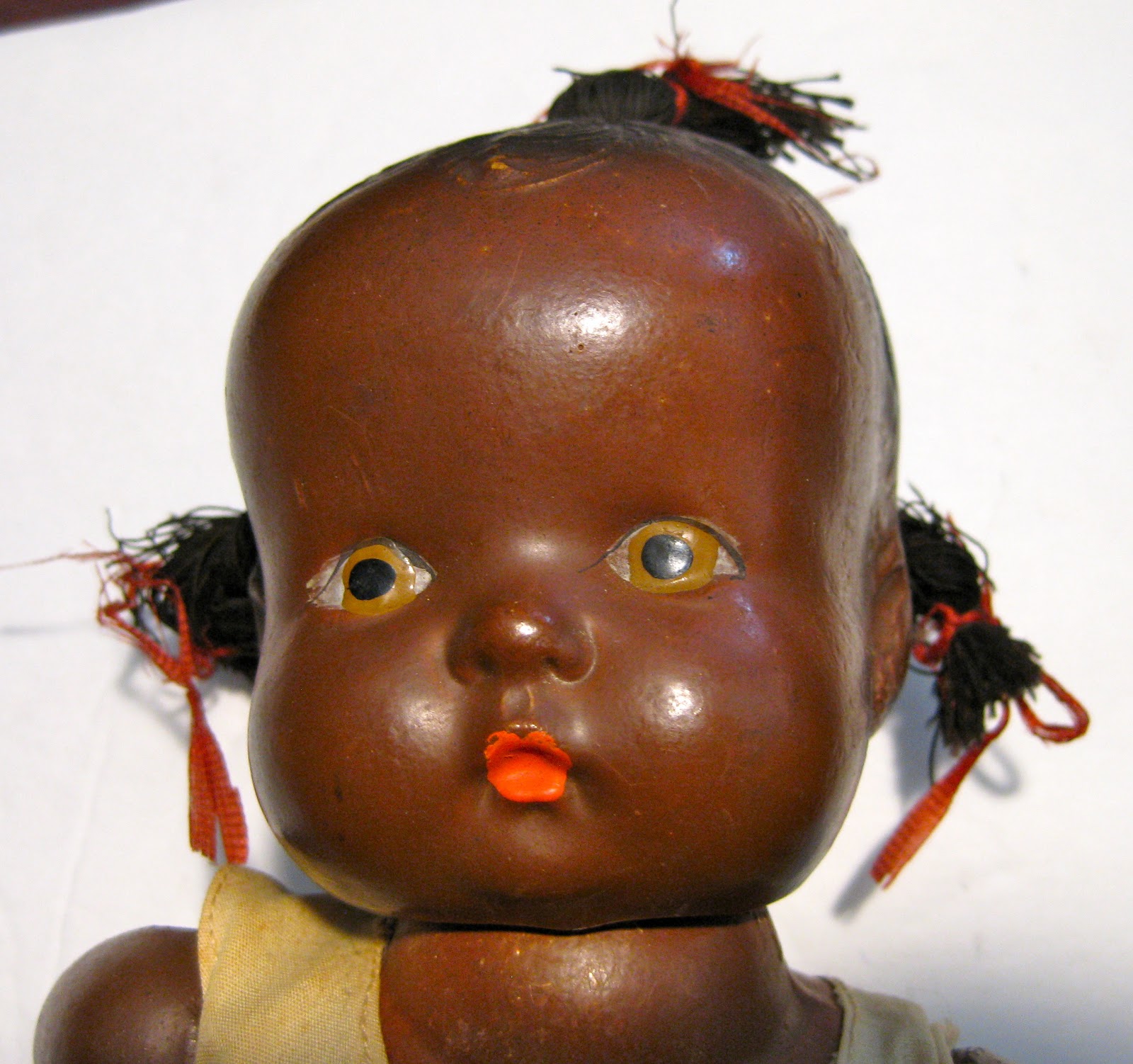

Wednesday, May 29, 2013
TIN CANTEEN DUG VICKSBURG
 I'm not sure what time period this canteen is from, but it was dug here in Vicksburg this past week. It's apparently made of tin with a soldered joint. The spout has threads, which I believe would indicate a post-Civil War production, perhaps 1880s to 1900s.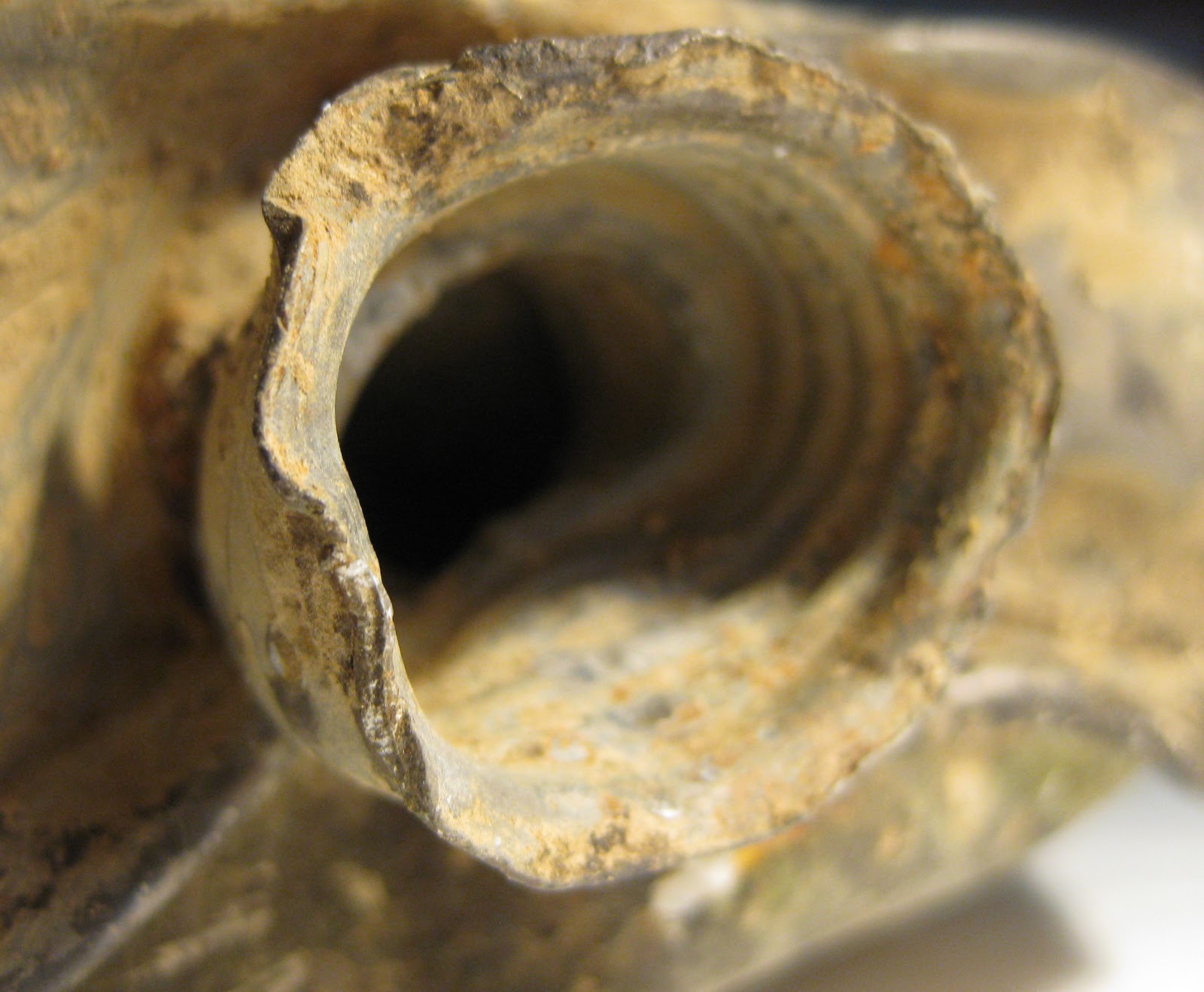

Monday, May 20, 2013
REPRO ART NOUVEAU

Wednesday, May 8, 2013
ANCIENT CRUCIFIX
 I purchased this Crucifix at an estate sale here in Vicksburg many years ago. It's one of my favorite pieces.
 The wooden cross and rendering of Jesus are meticulously carved
 I have no idea the age of the piece, but I would guess it is quite old.
Wednesday, May 1, 2013
WWII CAP - ID UNKNOWN
This cap was bought along with some other WWII relics a while back. I haven't been able to identify it. I suspect it may be French, but that's just a guess.

Monday, April 22, 2013
RUSSIA IN VICKSBURG VIA THE POSTAL SERVICE

Sunday, April 14, 2013
DUG VINTAGE DOLL PARTS
 Along with the bottles and miscellaneous other diggin's that come from old dumps and privies, one will find parts of early toys, like this assortment of ceramic and bisque doll arms, legs, eyeballs, etc.
  Many have numbers that identify the manufacturer and the country of origin. They're not worth much, but they are interesting.
 Friday, April 5, 2013
MORE TREASURE FROM VICKSBURG: A PLEYEL UPRIGHT PIANO
 This ca 1860 Pleyel piano, one of the very first uprights, came to us from an old family here in Vicksburg. It's in only fair condition; a restoration would yield a magnificent antique fit for the finest antebellum home. According to Wikipedia,
"Pleyel pioneered the player piano with the Pleyela line of pianos. These were often very small pianos of a very unusual design.
"Pleyel was the first to introduce the upright piano to France[citation needed], adapting the best features of pianos built in Britain. They introduced these pianos by 1815. Their pianos were such a success that in 1834 the company boasted 250 employees and an annual production of 1000 pianos."
Wednesday, March 27, 2013
CIVIL WAR MEDAL OF HONOR DONATED TO VNMP
 The Vicksburg National Military Park has been given the Medal of Honor awarded to Private Charles W. Rundle, who received the medal as a result of his actions during the charge of May 22, 1863, during the Siege of Vicksburg. According to documented evidence:
CHARLES WESLEY RUNDLE (December 14, 1842 –
July 11, 1924) was a Union
Army soldier of the American Civil War and
recipient of the United States military's highest decoration, the Medal of Honor, for his “gallantry in the charge of the ‘volunteer storming
party’” on May 22, 1863, during the Siege of Vicksburg. Private Rundle, of Co.
A, 116th Illinois Infantry, along with about 150 of his unmarried
comrades, volunteered to charge a heavily fortified Confederate fort in order
to lay bridges and place scaling ladders that were to be used later by a much
larger Union force when storming the position. As the volunteers charged the
fort across open ground, however, Confederate soldiers poured a withering fire of
both small arms and artillery upon the group, inflicting heavy casualties.
Their mission thwarted, Rundle and his surviving comrades sought protection
from the bombardment among the trenches at the base of the Confederate
position. Trapped throughout the remainder of the day, Rundle and about 30 of his
fellow soldiers finally succeeded in making their escape back to Union lines
after nightfall provided sufficient cover.

The Park is quite fortunate to have received the medal, donated to them by Rundle's Great-Great Grandson. It may be viewed at the park Visitors' Center.
Subscribe to:
Posts (Atom)